


In industrial automation and IoT data collection, selecting the correct connector is as critical as choosing the sensor itself. The physical link dictates signal integrity, power stability, and the overall lifespan of the equipment. This guide provides a direct technical comparison between the two most common interconnect standards: the M8 and M12 industrial sensor connectors. By understanding their specific mechanical and electrical specifications, engineers can make informed decisions to ensure long-term reliability in the field.
The Role of a Sensor Connector in Modern Industry

Sensors act as the nervous system of modern automated processes. However, a sensor is only as reliable as its connection. An industrial sensor connector does more than establish a basic physical link; it acts as a protective barrier for continuous data and power transmission in harsh environments. Standard commercial connectors frequently fail under industrial stresses, leading to intermittent signal loss, data corruption, or complete system shutdowns.
To guarantee operational stability, utilizing specialized rugged connectors is mandatory. Here is why specific parameters matter:
- Mechanical Stress Resistance: Continuous vibration and mechanical shock can loosen standard threads over time. Industrial connectors utilize precision-machined threaded locking mechanisms to maintain consistent contact pressure, preventing micro-interruptions in the signal.
- Ingress Protection: Industrial environments expose connections to dust, moisture, and cutting fluids, which rapidly degrade unprotected electrical contacts. Industrial-grade seals (such as FKM or NBR O-rings) prevent oxidation and short circuits, directly extending the MTBF (Mean Time Between Failures) of the sensor node.
- Electromagnetic Shielding (EMI/RFI): Factory floors with high-voltage machinery generate intense electrical noise. Properly shielded connectors with 360-degree EMI protection ensure clean signal transmission, which is critical for precise analog measurements and digital communications.
Specifying the correct interconnect solution during the initial design phase significantly reduces costly downtime and maintenance cycles later. If you are currently evaluating interconnect options for your BOM, exploring our standard and custom solutions can streamline your design process.
M8 vs M12 Connectors: What Are the Core Differences?
The choice between M8 and M12 is primarily driven by the balance between space constraints and electrical requirements. While both adhere to circular connector standards (IEC 61076-2-104 for M8 and IEC 61076-2-101 for M12), their performance envelopes differ significantly.
Comparison Table: Technical Specifications at a Glance
| Feature | M8 Connector | M12 Connector |
|---|---|---|
| Locking Thread | M8 x 1.0 | M12 x 1.0 |
| Common Pin Counts | 3, 4, 5, 6, 8 | 3, 4, 5, 8, 12, 17 |
| Standard Coding | A, B | A, B, C, D, X, S, T, K, L |
| Current Rating | Up to 4A (typical 3A) | Up to 16A (Power Codings) |
| Voltage Rating | 30V – 60V AC/DC | Up to 630V (S/K Coding) |
| Data Speed | Basic Signal / Fast Ethernet | Up to 10 Gbps (X-Coding) |
| Best Applications | Miniature Sensors, I/O boxes | Vision Systems, Motors, Fieldbus |
Related blog ➣ Understanding M12 Circular Connectors: Coding Applications
Size, Threading, and Form Factor
The most obvious distinction is the diameter. The M8 connector features an 8mm locking thread, making it the ideal miniature sensor connector for compact machinery, robotic grippers, and space-limited I/O modules. In contrast, the M12’s 12mm thread provides a more robust mechanical coupling.
The larger form factor of the M12 is not just for strength; it allows for thicker internal insulation and larger contact pins, which are essential for higher power delivery and complex shielding. If your project involves a Remote Tank Level Gauge or Wireless Pressure Transmitter where vibration is extreme, the M12’s larger threading offers superior pull-out resistance.
Pin Counts and Data Transmission
Pin density is a critical factor for system architecture.
- M8 Connectors: Usually capped at 6 or 8 pins. They are perfect for simple proximity sensors or small-scale M8 waterproof harnesses in PLC connections.
- M12 Connectors: Offer massive flexibility with up to 17 pins. A standard M12 4 pin sensor cable is the industry go-to for standard digital sensors.
Coding (keying) is another area where M12 excels. While M8 is primarily A-coded, M12 features specialized codings like D-code (for 100Mbps Ethernet) and X-code (for 10Gbps high-speed data). For high-bandwidth applications like Industrial IoT Sensors with integrated vision, the M12 is the only viable choice to prevent data bottlenecks.
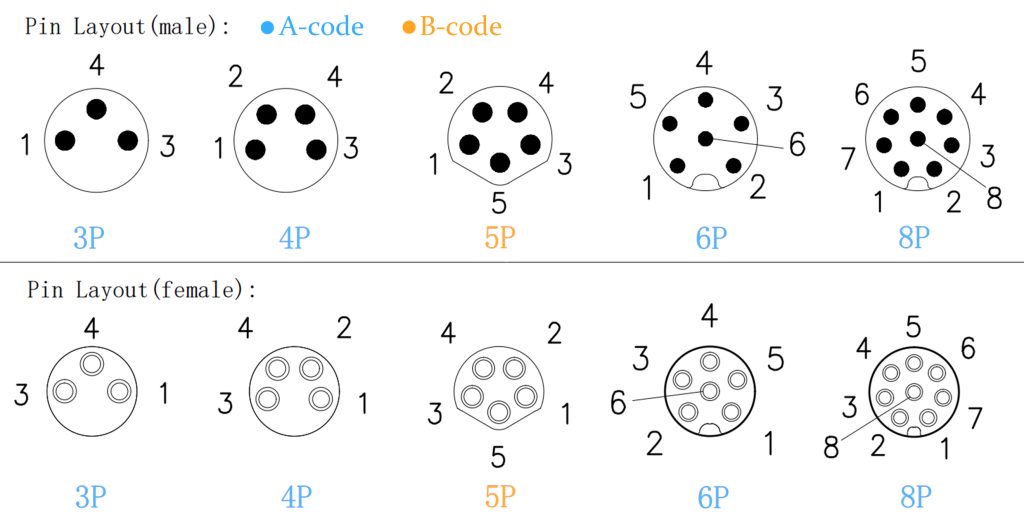
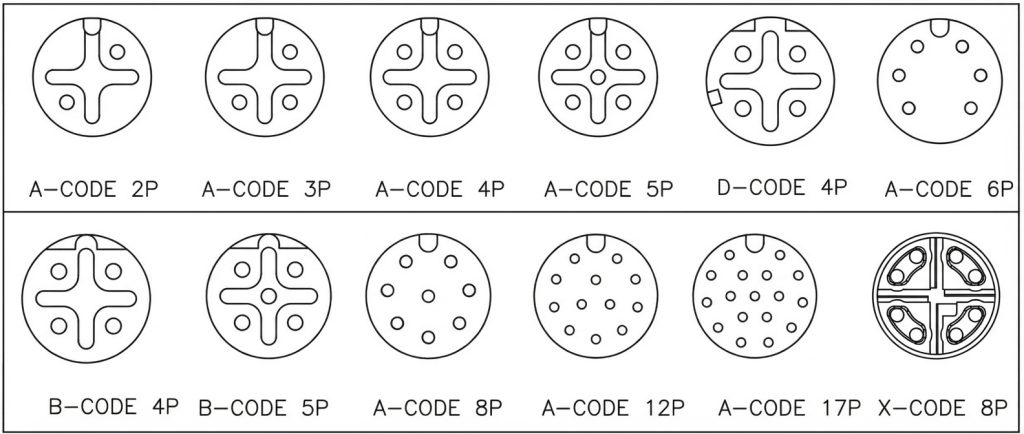
Identifying the right coding prevents accidental cross-mating, which could lead to equipment damage. If you are replacing an existing component and are unsure of the coding, our engineering team can provide a direct Cross-Reference evaluation to ensure our solutions meet or exceed your current OEM specifications.
Key Factors to Consider When Selecting Your Sensor Connector
Selecting a connector based solely on the number of pins and thread size is a common pitfall. To ensure the long-term integrity of an industrial sensor connector, engineers must evaluate the environmental and mechanical stresses unique to the application site.
Environmental Protection (IP Ratings & Sealing)
In industrial settings, “waterproof” is a broad term. You must define the specific level of ingress protection required.
- IP67: Protection against temporary immersion (up to 30 minutes at 1 meter). This is standard for most factory floor sensor connectors.
- IP68/IP69K: Essential for high-pressure washdowns or permanent submersion. In applications like a Remote Tank Level Gauge, an IP68-rated M12 connector prevents moisture from wicking into the electronics, which is a leading cause of sensor drift.
For high-moisture environments, look for connectors featuring FKM (Viton) O-rings. These provide superior chemical resistance compared to standard NBR seals, especially when exposed to oils and degreasers found in Oilfield Electronics.
Material Durability and Shielding
The housing material directly impacts the connector’s survival in corrosive environments.
- Plastic (PA66/PBT): Lightweight and cost-effective for general-purpose indoor automation.
- Nickel-Plated Brass: The industry standard for balanced durability and cost.
- Stainless Steel (316L): Mandatory for food processing or marine applications where salt spray or caustic cleaning agents are present.
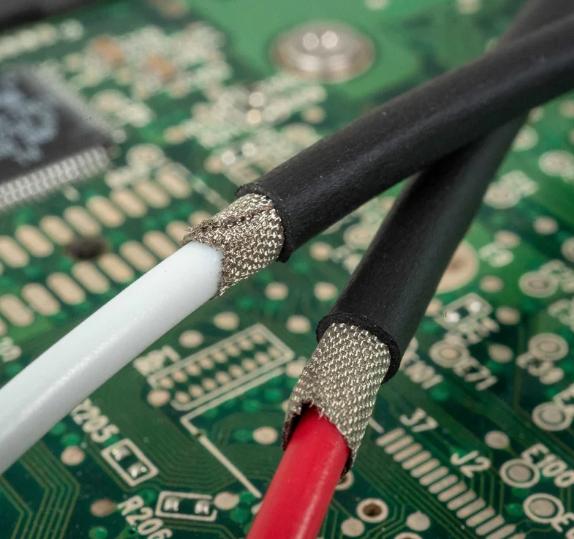
Additionally, for Wireless Pressure Transmitters or high-accuracy analog sensors, EMI shielding is non-negotiable. A shielded M12 4 pin sensor cable utilizes a braided mesh connected to the coupling nut to drain interference to the ground, preserving the signal-to-noise ratio.
Industry-Specific Needs and Customization
Different industries impose unique physical demands on cabling.
- Flex Life: For robotic arms, a “High-Flex” or “Torsion-Rated” M8 waterproof harness is required to withstand millions of bending cycles without conductor fatigue.
- Temperature Range: In Solar Powered Monitors located in desert environments, the connector and cable jacket (typically TPU or Teflon) must withstand UV radiation and temperatures exceeding 80°C.
If your project requires specific cable lengths or unique overmolding materials to meet UL or RoHS compliance, our team specializes in creating Custom Solutions tailored to your technical BOM.
Matching Connectors to Advanced Sensor Applications
As industries transition to Industry 4.0, sensor connectors are no longer passive components but vital enablers of real-time data flow. Selecting the right interface—whether M8 or M12—depends heavily on the specific “use case” and the infrastructure of the deployment site.
Industrial IoT (IIoT) and Wireless Monitoring
In IIoT frameworks, sensors often operate in remote or inaccessible locations. For a Wireless Pressure Transmitter or an Industrial IoT Sensor node, power efficiency and compact form factors are paramount. M8 connectors are frequently chosen here to maintain a small device footprint while providing a robust, waterproof connection for external antennas or battery charging ports.
Energy and Fluid Management Systems
Outdoor installations, such as a Solar Powered Monitor or a Remote Tank Level Gauge, face brutal UV exposure and thermal cycling. In these scenarios, M12 connectors with high-performance TPU jackets are preferred. Their larger contact surface area ensures stable electrical resistance even as materials expand and contract due to temperature swings, preventing false sensor readings in critical energy infrastructure.
FAQ
Contact Us
Ready to finalize your sensor design? Whether you need a standard M12 4 pin sensor cable or a custom M8 waterproof harness, our technical team is here to assist with cross-referencing and rapid prototyping. [Download Our Full M-Series Catalog] or [Contact Us for a Quote Today].

Connectors & cable assemblies manufacturer.
Sharing insights on connectors and real-world applications.
Contact for datasheets, samples, or inquiries.