


When selecting an M8 or M12 cable assembly, the connector size, pin configuration, coding, and electrical specifications are important—but the cable jacket material is also a critical part of the selection process. Two of the most commonly used jacket materials in industrial applications are PVC (Polyvinyl Chloride) and PUR (Polyurethane).
So, which is better: PVC or PUR cable?
The answer depends on the application. PVC cable is commonly used for general-purpose industrial wiring and stationary or moderately demanding installations, while PUR cable is often selected when greater abrasion resistance, flexibility, oil resistance, or repeated movement is required. However, the jacket material alone does not determine the performance of a cable. Cable construction, conductor design, shielding, bend radius, flex rating, temperature range, and the connector-to-cable transition should also be considered.
For M8 and M12 cable assemblies, this distinction is particularly important. These connectors are widely used for sensors, actuators, control systems, industrial automation, and other equipment where cables may be exposed to movement, vibration, moisture, abrasion, or industrial fluids. A cable that works well in a stationary installation may not be the right choice for a continuously moving application.
PVC vs PUR Cable: Quick Comparison
PVC and PUR are both widely used cable jacket materials, but they are suited to different operating conditions. In general, PVC cable is a practical choice for general-purpose and stationary installations, while PUR cable is often considered when the cable must withstand greater mechanical stress, repeated movement, abrasion, or exposure to certain industrial fluids.
The table below provides a quick comparison of the main characteristics to consider when selecting a cable jacket.
| Feature | PVC Cable | PUR Cable |
|---|---|---|
| Material | Polyvinyl Chloride | Polyurethane |
| General flexibility | Good, depending on cable construction | Often very good, depending on cable construction |
| Abrasion resistance | Good for many general-purpose applications | Often excellent |
| Oil resistance | Depends on specific formulation | Often better suited to oil-exposed applications |
| Chemical resistance | Suitable for many common environments | Good to excellent, depending on formulation and chemical |
| Repeated movement | Application dependent | Commonly selected for dynamic applications |
| Drag chain use | Only when specifically designed and rated | Commonly used when specifically designed for continuous flexing |
| Fixed installation | Very suitable | Suitable, but may not always be necessary |
| Typical cost | Generally lower | Generally higher |
| Common applications | General industrial wiring, sensors, control systems | Automation, robotics, moving machinery, demanding industrial environments |
The comparison should be used as a starting point rather than a universal rule. For M8 and M12 cable assemblies, the choice therefore depends not only on the connector itself but also on how and where the complete cable assembly will be installed.
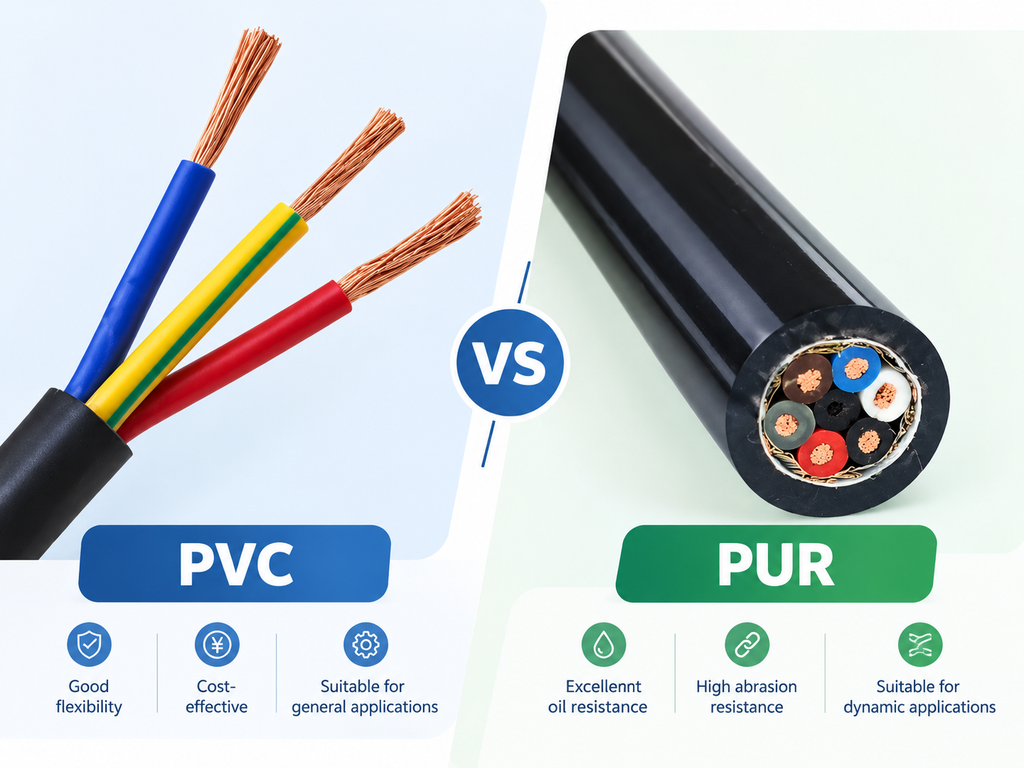
What Is a PVC Cable?
PVC cable is a cable that uses polyvinyl chloride (PVC) as the outer jacket or insulation material. PVC has been widely used in electrical and industrial cables because it provides a practical combination of electrical insulation, mechanical protection, flexibility, and cost efficiency.
The performance of a PVC cable does not come from the jacket material alone. Different PVC formulations and cable constructions can provide different levels of flexibility, temperature resistance, chemical resistance, and mechanical durability. For this reason, the term PVC cable describes the jacket material, but it does not by itself define the complete performance of the cable.
For industrial connectors such as M8 and M12, PVC-jacketed cables are commonly used in applications where the cable is fixed or experiences limited movement. They can be suitable for sensors, control systems, automation equipment, and general machine wiring where extreme abrasion or continuous flexing is not the primary concern.、
Advantages of PVC Cable
One of the main advantages of PVC cable is its versatility. PVC is available in a wide range of formulations, allowing manufacturers to produce cables for different electrical, mechanical, and environmental requirements.
1. Cost-Effective for General Applications
PVC is generally a cost-effective jacket material for many standard cable applications. When a cable is installed in a relatively controlled environment and does not experience severe mechanical stress, choosing a PVC cable can help keep the overall cable assembly cost under control.
This can be particularly useful for large-scale industrial installations where many sensor or control cables are required.
2. Good Electrical Insulation
PVC provides good electrical insulation properties and is widely used for wires and cables in industrial and electrical systems. Depending on the specific cable design, PVC can be used for signal, control, and other low-voltage applications.
3. Suitable for Fixed or Limited-Movement Installations
PVC cable can be a practical option when the cable remains stationary or only moves occasionally. Typical examples include connections between sensors and control equipment, fixed machine wiring, and installations where the cable is properly supported and protected from excessive mechanical stress.
4. Wide Range of Applications
Because PVC can be formulated for different requirements, PVC-jacketed cables are used across many industries. For M8 and M12 cable assemblies, typical applications can include industrial sensors, automation systems, control equipment, packaging machinery, and general machine wiring.
However, when the cable is repeatedly dragged, flexed, twisted, or exposed to significant abrasion, the cable should be selected based on its complete mechanical specifications rather than the PVC material alone.
What Is a PUR Cable?
PUR cable uses polyurethane (PUR) as the outer jacket or insulation material. PUR is widely used in industrial cable applications where the cable may be exposed to repeated movement, abrasion, mechanical stress, or certain oils and chemicals.
Compared with a general-purpose PVC cable, a properly designed PUR cable can offer advantages in demanding mechanical environments. However, PUR should not automatically be considered a replacement for PVC. The performance of a PUR cable still depends on its formulation, cable construction, conductor design, shielding, and the requirements of the application.
For this reason, PUR cable is particularly relevant to industrial automation, robotics, machine tools, material handling equipment, and other applications where cable movement or mechanical wear is an important consideration.
Advantages of PUR Cable
1. High Abrasion Resistance
One of the main reasons PUR is selected for industrial cable jackets is its resistance to mechanical wear. In applications where a cable repeatedly contacts machine components, cable carriers, or other surfaces, abrasion resistance can be an important factor in extending cable service life.
This makes PUR particularly relevant to moving machinery and applications where the cable is exposed to repeated mechanical contact.
2. Good Flexibility for Dynamic Applications
PUR cable jackets can provide good flexibility, but the flexibility of the complete cable depends on its construction. For applications involving repeated bending or movement, it is therefore important to select a cable that is specifically designed and rated for the required motion.
A PUR jacket alone does not guarantee that a cable is suitable for continuous flexing, drag chains, or robotic applications.
3. Resistance to Oil and Industrial Fluids
Certain PUR formulations provide good resistance to oils, lubricants, and other industrial fluids. This can make PUR cable a useful option for machinery where cable jackets may be exposed to cutting fluids, lubricants, or similar substances.
However, chemical resistance varies by PUR formulation and by the specific substance involved. The manufacturer’s chemical-resistance specifications should therefore be checked for demanding applications.
4. Suitable for Demanding Industrial Environments
The combination of flexibility, abrasion resistance, and resistance to certain industrial substances makes PUR cable a common choice for applications where a standard general-purpose cable may experience greater mechanical or environmental stress.
Typical examples include:
- Robotic equipment
- CNC and machine tools
- Drag chain systems
- Automated production equipment
- Moving sensors and actuators
- Material handling equipment
PVC vs PUR Cable: Key Differences
The differences between PVC and PUR become more important when a cable is exposed to movement, mechanical wear, industrial fluids, or changing environmental conditions. Instead of choosing a jacket material based on one property alone, it is better to compare the factors that directly affect the cable’s operating environment.
For industrial cable assemblies, five factors are particularly important: flexibility, abrasion resistance, oil and chemical resistance, temperature performance, and cost.
1. Flexibility and Continuous Flexing
Flexibility is one of the first factors to consider when comparing PVC and PUR cable. However, flexibility should not be judged by the jacket material alone.
A cable’s ability to bend repeatedly depends on its overall construction, including the conductor design, insulation, number and arrangement of cores, shielding, outer jacket, bend radius, and manufacturing process.
PUR is commonly selected for applications where cables need to move repeatedly because PUR jackets can provide good flexibility and mechanical durability. This makes PUR cable a common choice for moving machinery, robotics, and automation systems.
PVC cables can also be flexible, and some are specifically designed for dynamic applications. Therefore, the correct question is not simply “Is PUR more flexible than PVC?” but rather:
“Is this specific cable designed for the type and frequency of movement required by my application?”
For M8 and M12 cable assemblies, this distinction is particularly important. A cable connected to a stationary sensor may require very different mechanical characteristics from a cable routed through a moving machine or robotic system.
2. Abrasion Resistance
Abrasion resistance becomes important when a cable repeatedly rubs against another surface. This can occur in cable carriers, moving machinery, production equipment, and installations where the cable is exposed to mechanical contact.
PUR is often selected for applications where abrasion resistance is a priority. Its mechanical properties can make it suitable for environments in which the cable jacket experiences repeated rubbing or contact.
PVC can also provide good mechanical protection, particularly in general-purpose installations. However, if a cable is exposed to continuous mechanical wear, the cable should be selected according to its actual abrasion and flexing requirements rather than simply choosing a material based on its name.
For an M8 or M12 cable assembly installed on moving equipment, consider not only the jacket material but also the cable routing, bend radius, movement pattern, and potential contact points.
3. Oil and Chemical Resistance
Oil and chemical exposure can significantly affect cable jacket selection in industrial environments. Machine tools, production equipment, and automated systems may expose cables to lubricants, cutting fluids, cleaning agents, or other industrial substances.
Certain PUR formulations offer good resistance to oils and many industrial fluids, which is one reason PUR cable is frequently considered for demanding industrial applications.
PVC can also be formulated for different environmental requirements, and some PVC cables provide suitable resistance to oils or chemicals. However, resistance varies according to the specific compound and the chemical involved.
For this reason, avoid treating “PUR = oil resistant” or “PVC = not oil resistant” as universal rules. When chemical exposure is important, check the manufacturer’s resistance data for the specific cable and substance.
4. Temperature Performance
Temperature is another important consideration when selecting a cable jacket. Both PVC and PUR cables are available in different formulations and constructions, so there is no single temperature range that applies to every PVC or PUR cable.
The required temperature range should be evaluated based on the actual installation environment, including both the minimum and maximum operating temperatures.
For example, a cable used inside a controlled factory environment may have very different temperature requirements from a cable installed outdoors, near a machine tool, or in equipment exposed to significant temperature changes.
For M8 and M12 cable assemblies, always check the specific product datasheet for:
- Operating temperature
- Installation temperature, when specified
- Cable flexibility at low temperatures
- Connector temperature rating
- Overmold or cable-entry limitations
The cable jacket and connector should be considered as part of the complete assembly rather than as completely independent components.
5. Cost
Cost is often another difference between PVC and PUR cable. In many general-purpose applications, PVC can provide a cost-effective solution when its mechanical and environmental performance is sufficient for the installation.
PUR cable may have a higher initial cost, particularly when it is designed for demanding mechanical applications or continuous movement. However, initial purchase price should not be the only consideration.
For applications where cable replacement requires machine downtime or where the cable experiences significant mechanical wear, the total cost of ownership may also include maintenance, replacement frequency, and downtime.
Therefore, the most economical choice is not necessarily the cable with the lowest initial price. It is the cable that provides the required performance without introducing unnecessary material or specification costs.
PVC vs PUR Cable for M8 and M12 Cable Assemblies
When selecting an M8 or M12 cable assembly, the cable jacket should be considered together with the connector, overmold, strain relief, conductor construction, shielding, and installation environment. PVC and PUR can both be suitable for M8/M12 assemblies, but the better choice depends on whether the cable is fixed, occasionally moved, continuously flexed, exposed to abrasion, or used around industrial fluids.
M8 PVC Cable Assemblies
M8 PVC cable assemblies are commonly suitable for sensors, actuators, control devices, and other industrial connections where the cable is installed in a fixed or relatively stable position. PVC can provide a practical balance of electrical insulation, mechanical protection, flexibility, and cost for many standard automation applications.
For example, an M8 sensor mounted on a machine frame may only require the cable to be routed once and then remain in position during normal operation. In this situation, a PVC cable assembly may provide the required performance without adding the additional cost of a jacket material intended for more demanding dynamic applications.
Typical M8 PVC cable applications include:
| Application | Why PVC May Be Suitable |
|---|---|
| Fixed sensors | Limited cable movement |
| Control systems | General industrial wiring |
| Machine wiring | Stable routing |
| Factory automation | Moderate mechanical requirements |
| Stationary actuator connections | Limited flexing |
However, if the M8 cable is routed through a moving mechanism, repeatedly bent, exposed to continuous abrasion, or subjected to oil and coolant, the cable specification should be reviewed more carefully. A PUR cable may be more appropriate when the specific cable is designed and rated for these conditions.
M8 PUR Cable Assemblies
M8 PUR cable assemblies are often selected for more demanding industrial applications where cable durability and repeated movement are important. Typical examples include moving sensors, automated machinery, robotic equipment, and installations where the cable may experience repeated bending or abrasion.
For dynamic applications, however, the term “PUR” alone is not enough to confirm suitability. A PUR-jacketed cable should still have the appropriate construction and flex rating for the intended movement. The number of bending cycles, minimum bend radius, torsion requirements, cable routing, and surrounding mechanical conditions should all be considered.
For an M8 connector installed on a moving automation component, for example, the cable may experience significantly more mechanical stress than a fixed sensor cable. In this case, selecting a cable assembly designed for continuous or repeated flexing can be more important than simply selecting a connector with the correct M8 interface.
M12 PVC Cable Assemblies
M12 PVC cable assemblies are widely applicable to fixed or moderately dynamic industrial connections. M12 connectors are commonly used for sensors, actuators, control systems, and industrial automation equipment, and PVC can be a practical jacket option when the installation does not involve severe mechanical stress.
For example, an M12 cable connected to a fixed proximity sensor, photoelectric sensor, or control device may have limited movement after installation. If the cable is properly routed and protected from excessive abrasion, a PVC cable assembly may be sufficient for the application.
M12 PVC assemblies can therefore be considered when the main requirements are reliable connectivity, general mechanical protection, electrical insulation, and cost-effective installation rather than continuous mechanical movement.
M12 PUR Cable Assemblies
M12 PUR cable assemblies are often considered for demanding automation environments where the cable may be exposed to repeated movement, abrasion, oil, coolant, or other industrial conditions. They are commonly associated with applications such as machine tools, automated production lines, robotics, and moving equipment.
A key advantage of using a suitable PUR cable is that the jacket can be selected as part of a cable construction designed for mechanical durability. This can be particularly useful when an M12 connection is installed on equipment that moves repeatedly during every production cycle.
For example, an M12 PUR cable assembly may be considered for a moving actuator, robotic component, or cable carrier application. Before selection, the cable’s actual continuous-flex rating, bend radius, temperature range, and resistance data should be checked against the machine manufacturer’s requirements.
M8 vs M12: Does the Connector Size Determine the Cable Jacket?
No. The M8 or M12 connector size does not determine whether PVC or PUR should be used. Connector size primarily describes the connector’s mating interface and mechanical dimensions, while the cable jacket is selected according to the electrical, mechanical, and environmental requirements of the complete cable assembly.
This means that both M8 and M12 cable assemblies can be available with different cable jacket materials. The same connector family may be configured with PVC or PUR cable depending on the intended application.

How Application Conditions Change the Choice
The following simplified guide can help narrow down the initial choice:
| Application Condition | PVC Cable | PUR Cable |
|---|---|---|
| Fixed installation | ✓ | ✓ |
| General machine wiring | ✓ | ✓ |
| Stationary sensor | ✓ | ✓ |
| Limited movement | ✓ | ✓ |
| Repeated bending | Check specific rating | PUR often considered |
| Drag chain | Only if specifically designed | PUR often considered |
| Robotics | Only if specifically designed | PUR often considered |
| High abrasion | Check specification | PUR often considered |
| Oil/coolant | Check formulation | Check formulation |
| Cost-sensitive | Often suitable | May have higher initial cost |
How to Choose Between PVC and PUR Cable
Choosing between PVC and PUR cable depends on the actual installation environment. Check these five factors before selecting an M8 or M12 cable assembly.
1. Cable Movement Fixed or moving?
Fixed or limited movement: PVC may be suitable.
Repeated bending or continuous movement:
Choose a cable specifically rated for dynamic applications; PUR is often considered.
2. Abrasion & Mechanical Stress Will the cable experience friction or mechanical stress?
For cables exposed to repeated rubbing, moving machinery, or drag chains, check the cable’s abrasion resistance, bend radius, and flex rating. PUR is often selected for demanding mechanical environments.
3. Oil & Chemicals Will the cable contact oil, coolant, or chemicals?
Check the specific cable’s resistance data for lubricants, coolant, cleaning agents, or other chemicals. Do not select based on jacket material alone.
4. Temperature & Bend Radius Are the temperature and routing conditions suitable?
Check the cable’s operating temperature, minimum bend radius, and flex requirements. For M8/M12 assemblies, also consider the connector and overmold specifications.
5. Total Cost Look beyond the cable price alone.
PVC is often more cost-effective for general applications. PUR may cost more initially but can be appropriate when higher mechanical or environmental performance is required.
Quick Rule
Fixed & general-purpose → PVC may be suitable
Dynamic & demanding → Consider a properly specified PUR or dynamic cable
Frequently Asked Questions About PVC vs PUR Cable
These questions address common cable selection problems for M8 and M12 cable assemblies in industrial applications.
Can I use an M8 or M12 PVC cable in a moving application?
Yes, but only if the specific PVC cable is designed and rated for the required movement. Check the cable’s continuous-flex rating, minimum bend radius, conductor construction, and expected movement cycles. For drag chains or continuous machine-axis movement, choose a cable specifically designed for dynamic applications rather than selecting it based on the jacket material alone.
My M12 cable is exposed to oil or coolant. Should I choose PUR?
PUR is often considered for applications exposed to oil, coolant, or other industrial fluids, but the jacket material alone does not determine chemical resistance. Check the cable manufacturer’s resistance data against the actual lubricant, cutting fluid, cleaning agent, temperature, and exposure conditions. For CNC machines and machine-tool applications, verify the specifications of the complete cable rather than assuming that all PUR cables have the same resistance.
Why does my cable fail near the M8 or M12 connector even though the cable jacket is still intact?
Cable failures can begin at the connector-to-cable transition because repeated bending can concentrate mechanical stress near the connector entry point. In addition to the jacket material, check the overmold, strain relief, minimum bend radius, cable routing, and movement pattern. A durable PUR jacket cannot compensate for unsuitable cable construction or inadequate strain relief. For moving M8 or M12 applications, evaluate the complete connector-to-cable design.
Can I replace an existing PVC M8/M12 cable with a PUR cable without changing the connector?
In many cases, the same M8 or M12 connector interface can be used with different cable jacket materials, but a PUR cable should not be treated as a simple drop-in replacement. The new cable must match the connector cable-entry size, termination or overmold requirements, electrical specifications, cable diameter, and minimum bend radius. If the application has changed from fixed installation to continuous movement, the complete cable assembly should be evaluated.
How do I choose between PVC and PUR for an M8/M12 sensor that moves with a machine?
Start by identifying the type of movement: occasional bending, repeated bending, continuous flexing, or twisting. Then check the bending frequency, minimum bend radius, cable routing, abrasion points, temperature, and exposure to oil or coolant. Select a cable construction and flex rating that match these conditions. PUR is often considered for demanding dynamic applications, but the complete cable specification remains more important than the jacket material alone.
Should I choose PVC or PUR if the cable is installed in a drag chain?
Do not choose a drag-chain cable based on the jacket material alone. The cable should be specifically designed and rated for continuous flexing in the intended cable carrier. Check the continuous-flex rating, minimum bend radius, conductor construction, cable diameter, installation conditions, and expected movement cycles. PUR cables are commonly considered for demanding drag-chain applications, while some PVC cables are also engineered for dynamic use. The key question is whether the specific cable is designed for the intended drag-chain application.
Explore M Series Cable products
For M8, M9, M12, and 7/8 cable assemblies, Renhotec Industrial can provide different cable configurations and PVC or PUR jacket options based on application requirements. Our cable assemblies can be selected according to connector type, pin configuration, cable construction, cable length, and installation environment.

As a Product Manager at Renhotec Group (est. 2008), I specialize in providing deep technical insights into connectors, cables, and custom electronic components. Renhotec is a global leader in interconnect solutions, dedicated to manufacturing high-standard products for diverse industries as your trusted technical partner.